
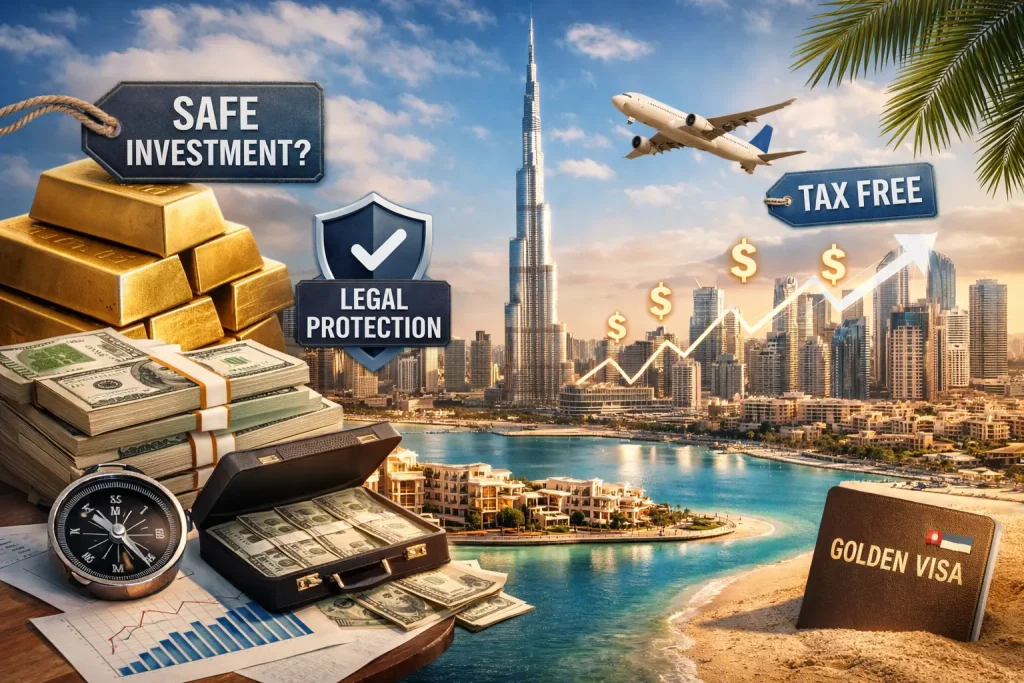
You have worked hard for your money. The last thing you want is to watch it disappear in a bad investment. So when Dubai keeps coming up in conversations about property, it is fair to ask: is it actually safe, or just smart marketing?
The short answer is yes. Dubai real estate is one of the more secure investment options available to global buyers today. But that answer deserves a proper explanation. This guide covers the real reasons behind Dubai’s reputation as a safe property market, including the legal protections, market data, key investment areas, and a straight-talking look at what risks still exist.
Whether you are a first-time buyer or a seasoned investor exploring your next move, this guide gives you the full picture.
Why Dubai Real Estate is a Safe Investment for Global Buyers
Think of Dubai as a city that was built with investors in mind. Everything from its tax structure to its legal framework has been designed to attract and protect foreign capital. That is not an accident. It is deliberate policy.
Here is a quick look at what makes Dubai stand apart from other markets:
- Zero property tax and zero capital gains tax. Every dirham of rental income or profit from a sale stays with you. In cities like London or Toronto, taxes can quietly consume 1% to 2% of your property’s value every year.
- UAE Dirham pegged to the US Dollar. This removes currency risk for dollar-based investors. Your returns are not going to be eroded by sudden exchange rate swings.
- Rental yields of 6% to 9% annually. Compare that to 2% to 3% in most Western cities. Dubai consistently offers stronger income on the same invested capital.
- Over 120,000 property transactions in 2023. The highest number ever recorded. This is a market driven by genuine demand, not speculation.
- Buyers from over 180 nationalities. The breadth of international interest is itself a strong signal of market confidence.
If you are considering where to put your money in property, browse the current listings at Versa Heights to see what is available across Dubai’s top investment areas.
Is Dubai Safe for Property Investment? Key Factors to Consider
When people ask whether Dubai is safe for property investment, they usually mean two things: Is the city itself safe? And is my money safe? Both questions are fair.
Physical Safety
Dubai consistently ranks among the safest cities in the world. Crime rates are very low, the government is stable, and there is no significant civil unrest inside the UAE. For a property owner, that kind of stability is directly linked to long-term value. Properties in safe, well-governed cities hold their value better.
Financial and Legal Safety
This is where Dubai has done the most work. The real estate market is regulated by two key government bodies:
- Dubai Land Department (DLD): The official authority for all property transactions. Every sale must be registered here, creating a government-backed ownership record.
- Real Estate Regulatory Agency (RERA): RERA licenses all developers and agents, maintains public registers, and provides a formal dispute resolution process for buyers.
One of the most important protections is the mandatory escrow system for off-plan properties. When you buy a property under construction, your payments go into a government-supervised escrow account. The developer can only draw on those funds at specific, verified construction milestones. If the developer fails to deliver, your money is protected. This is one of the main reasons buyers feel confident purchasing off-plan in Dubai.
Currency Safety
The UAE Dirham has been pegged to the US Dollar since 1997. This removes one of the most common risks in emerging market investments: currency depreciation. An investor from the US, Europe, or Asia can be confident that their returns will not be wiped out by a sudden shift in exchange rates.
Understanding Dubai Property Market Stability in 2024
Markets go through cycles. The right question is not whether a market ever dips. It is how quickly it recovers, and what protections exist for investors during the dip.
Dubai’s market did take hits in 2008 and again in 2015. Both times, it recovered. And each recovery brought stronger regulations and a more diversified economic base.
| Year / Event | Market Impact | Recovery Time | Key Outcome |
|---|---|---|---|
| 2008 Global Financial Crisis | Sharp price decline | 3-4 years | RERA reforms strengthened |
| 2015 Oil Price Drop | Moderate price softening | 2-3 years | Economic diversification accelerated |
| 2020 COVID-19 | Brief transaction slowdown | Under 12 months | Remote work visas introduced |
| 2023 Record Year | 120,000+ transactions | N/A (peak year) | Strongest market ever recorded |
What keeps the market stable today is structural. Dubai’s economy is no longer dependent on oil. Tourism, finance, logistics, and technology now form the backbone of economic activity. The city attracted over 17 million tourists in 2023, which keeps rental demand consistently high.
Population growth is another anchor. Dubai’s population has been growing steadily, driven by professionals and families relocating from Europe, Asia, and the wider Middle East. More residents means more demand for housing, and more demand supports property values.
You can explore properties across different price points and neighborhoods at Versa Heights Projects, including both ready and off-plan options.
Dubai Safe Haven Real Estate: Why Investors Flock Here
In finance, a “safe haven” is an asset that holds its value when other investments are struggling. Gold is the classic example. Increasingly, Dubai property is being grouped into the same conversation.
The reasons are tangible:
- No property tax. Annual property tax in the UK or US can cost 1% to 2% of property value each year. In Dubai, that cost does not exist.
- No capital gains tax. Sell your Dubai property for a profit and you keep the full amount.
- Golden Visa program. Buyers of property worth AED 2 million or more qualify for a 10-year UAE residency visa. This draws investors who want to diversify both their assets and their lives.
- High rental demand. Dubai has a large expat population that rents rather than buys. Occupancy rates in key areas regularly exceed 90%.
- World-class infrastructure. Roads, airports, schools, and hospitals built to a very high standard attract high-income residents who support strong rental prices.
- Strategic global position. Dubai connects Europe, Asia, and Africa. That geography makes it a permanent node for global business, which keeps property demand high.
For buyers seeking a high-value entry point, Mr C Residences and The Alba Residences Dorchester Collection represent premium properties that consistently hold and grow in value.
Is It Smart to Invest in Dubai During War and Global Uncertainty?
This is one of the most common concerns from new investors, and it deserves a direct answer. The Middle East has seen conflict. If you are putting serious capital into the region, you need to know where Dubai actually stands.
- The UAE shares no direct border with any active conflict zone.
- The government maintains a deliberate policy of diplomatic neutrality and economic engagement with multiple global powers.
- In 2020, the UAE signed the Abraham Accords with Israel, further broadening its international trade relationships.
- During every major regional conflict over the past decade, including the Syria crisis, the Yemen conflict, and the 2023 Gaza situation, Dubai’s property market continued to transact and often attracted more investment as regional wealth moved toward stability.
During COVID-19, Dubai demonstrated similar resilience. While major global cities froze, Dubai reopened quickly, introduced remote work visas, and saw property transactions recover within months.
Investors who bought in Dubai during the Arab Spring in 2011, the oil price drop in 2015, COVID in 2020, and during the 2023 regional tensions have largely seen positive returns. That track record is consistent.
Does geopolitical risk exist? Yes, and any honest adviser will say so. But risk is not the same as danger. Dubai’s track record of navigating regional instability while keeping its property market intact is well-established.
Legal Protections That Make Dubai Property Investment Secure
A real estate market is only as safe as its legal system. Dubai has built a framework that is genuinely investor-friendly, especially for foreign buyers who want clarity and protection.
| Legal Protection | What It Means for You |
|---|---|
| Freehold Ownership for Foreigners | In designated areas, foreign nationals own property outright with full rights to sell, rent, or pass to heirs. |
| Mandatory Title Deed Registration | Every transaction is registered with the DLD. There is a clear, government-backed record of ownership. |
| Escrow Accounts for Off-Plan Purchases | Your payments go into a supervised escrow account. Developers can only access funds at verified construction milestones. |
| RERA Licensing Requirements | Only registered developers and agents can operate. You can verify anyone on RERA’s public register before signing. |
| RERA Dispute Resolution Process | Disputes go through a formal process before reaching court. Faster and more accessible for buyers. |
| Golden Visa Residency Rights | Investors with AED 2M+ in property qualify for a 10-year residency visa, tied to ownership, not employment. |
According to the Dubai Land Department, property registrations have grown year-on-year, and the regulatory framework has been continuously refined to match the scale of international investment in the market.
If you want to understand how these protections apply to a specific purchase, the team at Versa Heights can walk you through every step from initial search to title deed handover.
Top Areas in Dubai Offering Safe and High-Return Investments
Not every part of Dubai delivers the same results. Just like different neighborhoods in any major city attract different buyers and generate different returns, Dubai has distinct zones with their own investment profiles.
| Area | Avg. Rental Yield | Best For | Entry Price (Approx.) |
|---|---|---|---|
| Jumeirah Village Circle (JVC) | 7% to 9% | Budget investors, high occupancy rates | From AED 550K |
| Dubai Marina | 6% to 8% | Expat renters, short-term lets, resale value | From AED 1.2M |
| Downtown Dubai | 4% to 6% | Capital growth, premium long-term holds | From AED 1.5M |
| Palm Jumeirah | 5% to 7% | Ultra-premium buyers, luxury rental market | From AED 3M |
| Business Bay | 5% to 7% | Professional tenants, mixed-use demand | From AED 900K |
| Dubai South | Emerging | Long-horizon investors, airport-linked growth | From AED 500K |
For buyers in the JVC range, Binghatti Hills Phase 2 starts from AED 550K and offers strong yield potential. In the mid-range, Samana Park Meadows and Azizi Milan 51 are both worth reviewing.
At the premium end, Palm Jebel Ali Frond B and Sobha Estates Villas represent some of the most sought-after addresses in the city.
Not sure which area aligns best with your goals and budget? The consultants at Versa Heights can help you narrow it down with data-backed guidance.
Future Outlook: Will Dubai Remain a Safe Real Estate Investment?
Looking ahead, the fundamentals supporting Dubai’s real estate market are not weakening. They are strengthening.
Dubai 2040 Urban Master Plan
The government has a detailed long-term development roadmap covering the next two decades: new residential districts, improved public transport, expanded green spaces, and continued economic diversification. Long-term planning at this scale creates a stable foundation under property values.
Al Maktoum International Airport Expansion
One of the largest infrastructure projects in the world. The expanded Al Maktoum airport is expected to handle over 260 million passengers annually when complete. That is more than double the current capacity of Dubai International Airport. More passengers mean more tourism, more business activity, and more housing demand. Bay Grove Residences Phase 3 and developments near Dubai South are already well-positioned to benefit.
Growing Technology and Finance Sector
Dubai is actively building itself as a global hub for technology and financial services. The Dubai International Financial Centre (DIFC) hosts hundreds of global institutions. Favorable regulations are drawing tech companies and startups, and as these sectors grow, demand for quality housing grows with them.
According to the IMF World Economic Outlook, the UAE is among the faster-growing economies in the region, with sustained GDP growth projected through 2026. That macroeconomic momentum is a consistent tailwind for property values.
The honest picture: No market is risk-free. A global recession, a sharp shift in oil prices, or an unexpected regional event could slow growth. But the trajectory, the infrastructure investment, and the regulatory environment all point toward continued stability and growth.
Investors with a five to ten year horizon and a clear strategy matched to the right area are well positioned in Dubai’s market right now.
Frequently Asked Questions
Is Dubai real estate a safe investment compared to other markets?
Yes, Dubai compares very favorably. Rental yields are 6% to 9%, which is two to three times higher than in cities like London or New York. There is no property tax and no capital gains tax. The legal framework is transparent and well-regulated, and the market has a consistent track record of recovering from global downturns. Like any investment, it carries some risk. But the risk-to-return profile is strong relative to comparable global markets.
How stable is the Dubai property market for long-term investors?
Very stable over a five to ten year horizon. The market has recovered from the 2008 financial crisis, the 2015 oil price drop, and COVID-19. Government infrastructure investment, consistent population growth, and economic diversification all support long-term values. The Golden Visa has also encouraged a class of long-term owner-investor, which creates a more stable ownership base.
Is Dubai safe for property investment during economic downturns?
Dubai has shown strong resilience during past downturns. The post-COVID recovery was notably fast. The escrow system protects off-plan buyers if a developer runs into financial difficulty. The DLD’s regulatory framework also provides structural stability that many markets lack. No market is fully recession-proof, but Dubai’s response to past downturns has been quicker and better structured than most comparable cities.
Why do investors consider Dubai a safe haven for real estate?
The combination of zero property tax, zero capital gains tax, a dollar-pegged currency, high rental yields, strong legal protections, and a 10-year Golden Visa makes Dubai uniquely attractive. When other markets are volatile, capital tends to flow toward Dubai because it offers predictability. That pattern has repeated itself multiple times over the past decade.
Can I safely invest in Dubai property if there is war in the region?
The UAE has maintained political neutrality and internal stability throughout every regional conflict in recent memory. Dubai sits outside any active conflict zones. Historical data shows that regional instability has actually driven investment into Dubai, as investors moved capital toward a stable alternative. Any investor should still assess personal risk tolerance and diversify appropriately.
What legal safeguards protect foreign investors in Dubai real estate?
Foreign investors benefit from freehold ownership rights in designated areas, mandatory title deed registration with the DLD, escrow account protections on off-plan purchases, RERA licensing requirements for all agents and developers, formal dispute resolution processes, and Golden Visa residency rights tied to property ownership. Together, these protections create one of the more transparent and investor-friendly regulatory environments in the region.
Ready to Explore Dubai Property Investment?
Dubai real estate is not a get-rich-quick play. It is a serious, well-regulated market with strong fundamentals, improving infrastructure, and a legal framework built to protect buyers.
The right starting point is understanding your goals. Are you after rental income, capital growth, or both? Off-plan or ready properties? Short horizon or long? The answers shape which areas and projects make the most sense for you.
The team at Versa Heights Real Estate works with investors at every stage, from first-time buyers to experienced portfolio holders. View all current listings or get in touch directly to start the conversation.


